
Bioinformatics ReviewBioinformatics Review
Notification Show More
Font ResizerAa
  •  Home
  • Docking
  • MD Simulation
  • Tools
  • More Topics
    • Softwares
    • Sequence Analysis
    • Algorithms
    • Bioinformatics Programming
    • Bioinformatics Research Updates
    • Drug Discovery
    • Phylogenetics
    • Structural Bioinformatics
    • Editorials
    • Tips & Tricks
    • Bioinformatics News
    • Featured
    • Genomics
    • Bioinformatics Infographics
  • Community
    • BiR-Research Group
    • Community Q&A
    • Ask a question
    • Join Telegram Channel
    • Join Facebook Group
    • Join Reddit Group
    • Subscription Options
    • Become a Patron
    • Write for us
  • About Us
    • About BiR
    • BiR Scope
    • The Team
    • Guidelines for Research Collaboration
    • Feedback
    • Contact Us
    • Recent @ BiR
  • Subscription
  • Account
    • Visit Dashboard
    • Login
Font ResizerAa
Bioinformatics ReviewBioinformatics Review
Search
Have an existing account? Sign In
Follow US
Function PredictionTools

smORFunction: A Tool for ORFs and Microproteins Function Prediction

Tariq Abdullah
Last updated: October 30, 2020 4:45 pm
Tariq Abdullah
Share
2 Min Read
smORFunction: A tool for ORfs and microproteins function prediction
SHARE

small open reading frames (smORFs) that are less than 100 codons in length are considered significant. smORFs participate in a variety of biological processes such as muscle formation and contraction. Therefore, it is considered essential to identify the functions of these smORFs. For this purpose, a new tool called smORFunction has been developed [1].

Contents
  • How does smORFunction work?
    • References

smORFunction can predict functions of smORFs or microproteins in 265 models generated from 173 datasets. These datasets include tissues/cells, diseased, and normal. The webtool of smORFunction is available at https://www.cuilab.cn/smorfunction. Currently, it consists of 617,462 unique smORFs that are annotated by different tools SmPROT and sORFs.org. The data source can be downloaded from https://www.cuilab.cn/smorfunction/download.

How does smORFunction work?

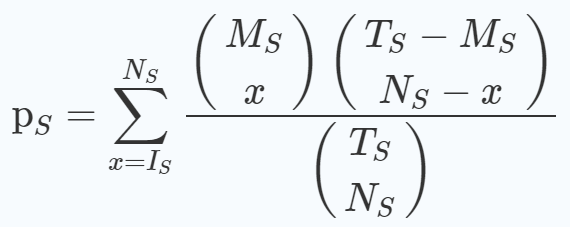
It uses hypergeometric distributions for function prediction followed by the calculation of p-value for a set of functional genes using the following equation [1]:
smORFunction

Here, Ts =total background genes

Ms = genes present in a functional gene set

Is = screened genes to be correlated

A summarized p-value is calculated for all datasets using the following equation [1]:
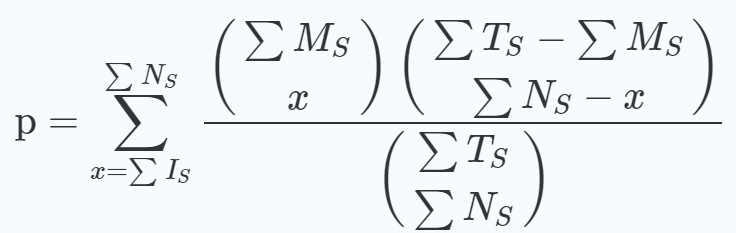
smorfunction


smORFunction provides several options to search such as users can search using BLAST or exact mode or by coordinate in reference genome (GRCh37 or GRCh38). The performance and accuracy has been validated on 270 microproteins collected from literature and database. It can predict functions in at most 82 diseases (and normal), 48 tissues/cells. It also includes GO terms, KEGG pathways, and REACTOM pathways.

For further information, read here.


References

  1. Ji, X., Cui, C., & Cui, Q. (2020). smORFunction: a tool for predicting functions of small open reading frames and microproteins. BMC bioinformatics, 21(1), 1-13.

TAGGED:Function predictionmicroproteinsORFs
Share This Article
Facebook Copy Link Print
ByTariq Abdullah
Tariq is founder of Bioinformatics Review and Lead Developer at IQL Technologies. His areas of expertise include algorithm design, phylogenetics, MicroArray, Plant Systematics, and genome data analysis. If you have questions, reach out to him via his homepage.
Leave a Comment

Leave a Reply Cancel reply

You must be logged in to post a comment.

ai tools vs traditional tools in bioinformatics
AI Tools vs Traditional Tools in Bioinformatics- Which one to select?
Algorithms Artificial Intelligence Machine Learning Software Tools
AI vs Physics in Molecular Docking
AI vs Physics in Molecular Docking: Towards Faster and More Accurate Pose Prediction
Artificial Intelligence Drug Discovery Machine Learning
10 years of Bioinformatics Review: From a Blog to a Bioinformatics Knowledge Hub!
Editorial
Starting in Bioinformatics? Do This First!
Tips & Tricks

You Might Also Like

How to see ligand interactions and label residues in DS Visualizer?
Tips & Tricks

How to see ligand interactions and label residues in DS Visualizer?

March 25, 2025
SoftwareTools

Cytoscape.js : A graph library for network visualization and analysis

May 20, 2020
PyMol: Uses & Applications
SoftwareTools

PyMol: Uses & Applications

March 1, 2022
Installing clustalw2 command-line tool on Ubuntu
Sequence AnalysisSoftwareTools

How to install ClustalW2 on Ubuntu?

August 3, 2024
Copyright 2024 IQL Technologies
  • Journal
  • Customer Support
  • Contact Us
  • FAQs
  • Terms of Use
  • Privacy Policy
  • Cookie Policy
  • Sitemap
Welcome Back!

Sign in to your account

Username or Email Address
Password

Lost your password?

Not a member? Sign Up