Bioinformatics ReviewBioinformatics Review
Notification Show More
Font ResizerAa
  •  Home
  • Docking
  • MD Simulation
  • Tools
  • More Topics
    • Softwares
    • Sequence Analysis
    • Algorithms
    • Bioinformatics Programming
    • Bioinformatics Research Updates
    • Drug Discovery
    • Phylogenetics
    • Structural Bioinformatics
    • Editorials
    • Tips & Tricks
    • Bioinformatics News
    • Featured
    • Genomics
    • Bioinformatics Infographics
  • Community
    • BiR-Research Group
    • Community Q&A
    • Ask a question
    • Join Telegram Channel
    • Join Facebook Group
    • Join Reddit Group
    • Subscription Options
    • Become a Patron
    • Write for us
  • About Us
    • About BiR
    • BiR Scope
    • The Team
    • Guidelines for Research Collaboration
    • Feedback
    • Contact Us
    • Recent @ BiR
  • Subscription
  • Account
    • Visit Dashboard
    • Login
Font ResizerAa
Bioinformatics ReviewBioinformatics Review
Search
Have an existing account? Sign In
Follow US
Bioinformatics Programming

A perl script to convert multiline FASTA sequences into a single line

Dr. Muniba Faiza
Last updated: May 20, 2020 5:48 pm
Dr. Muniba Faiza
Share
2 Min Read
SHARE

There are different software or tools which require different kinds of input, especially, when you are trying to developing a pipeline or want to process multiple large files.

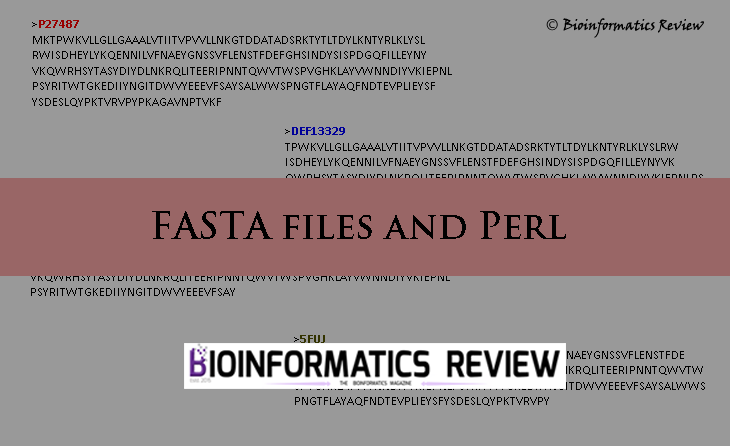
If you are dealing with a big FASTA file consisting of thousands of sequences split into a particular number of residues per line, and you want each sequence into a single line, then you can use this simple Perl program.

There are two cases to input your multiline fasta file, either you define the filename in your Perl script or get it through the command line.

1. Define input file within the script

The multifasta input file is “input.fasta”.

#!/usr/bin/perl
use strict;
use warnings;
my $input_fasta = "input.fasta";
open(IN,"<", "input_fasta") || die ("Can't open $input_fasta $!");

my $line = <IN>;
print $line;

while ($line = <IN>)
{
chomp $line;
if ($line=~m/^>/gi) { 

   print "\n",$line,"\n";
}
else { 
print $line; 
}
}

print "\n";

2. As a command-line argument

#!/usr/bin/perl
use strict;
use warnings;
my $input_fasta = $ARGV[0];
open(IN,"<", "$input_fasta") || die ("Can't open $input_fasta $!");

my $line = <IN>;
print $line;

while ($line = <IN>)
{
chomp $line;
if ($line=~m/^>/gi) { 

   print "\n",$line,"\n";
}
else { 
print $line; 
}
}

print "\n";

TAGGED:FastamultifastaPerlsequences
Share This Article
Facebook Copy Link Print
ByDr. Muniba Faiza
Follow:
Dr. Muniba is a Bioinformatician based in New Delhi, India. She has completed her PhD in Bioinformatics from South China University of Technology, Guangzhou, China. She has cutting edge knowledge of bioinformatics tools, algorithms, and drug designing. When she is not reading she is found enjoying with the family. Know more about Muniba
Leave a Comment

Leave a Reply Cancel reply

You must be logged in to post a comment.

How to visualize a 3D structure using Py3Dmol?
Bioinformatics Programming Cheminformatics GitHub Python
ai tools vs traditional tools in bioinformatics
AI Tools vs Traditional Tools in Bioinformatics- Which one to select?
Algorithms Artificial Intelligence Machine Learning Software Tools
AI vs Physics in Molecular Docking
AI vs Physics in Molecular Docking: Towards Faster and More Accurate Pose Prediction
Artificial Intelligence Drug Discovery Machine Learning
10 years of Bioinformatics Review: From a Blog to a Bioinformatics Knowledge Hub!
Editorial

You Might Also Like

Bioinformatics Programming

What is Numerical Taxonomy? How is it useful?

March 24, 2019
How to extract x,y,z coordinates of atoms from PDB file?
Bioinformatics ProgrammingPython

How to extract x,y,z coordinates of atoms from PDB file?

May 11, 2022
basic sql queries
Bioinformatics Programming

Basic SQL Queries to Create and Retrieve Information from a Database

September 19, 2020
Bioinformatics ProgrammingPython

dssp_parser: A new Python package to extract helices from DSSP files.

May 10, 2022
Copyright 2024 IQL Technologies
  • Journal
  • Customer Support
  • Contact Us
  • FAQs
  • Terms of Use
  • Privacy Policy
  • Cookie Policy
  • Sitemap
Welcome Back!

Sign in to your account

Username or Email Address
Password

Lost your password?

Not a member? Sign Up